|
|
|
| Product classification
> Ultrasonic flowmeter >
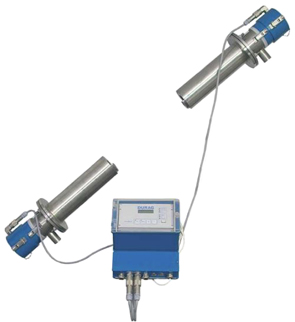
D-FL200 Series
(GAS) |
| D-FL200
Series
(GAS) |

|
|
|
|
|
|
|
| No
|
Model
Name
|
PDF
Download
|
| Catalog
| English
Operating Manual
|
| 1
| Ultrasonic flow meter
(GAS)
(D-FL200 Series)
|  Download
[384.0 KB] Download
[384.0 KB] | Download
[1166.0 KB] |
|
|
|
|
| |
|
|
 Product
Feature Product
Feature
|
•
In-situ
measuring method
•
Measurement
possible below dew point and for high dust concentrations
•
Continuous
measurement of normal volume flow and gas velocity
•
Automatic
zero point and reference point control
•
Direct
connection for temperature and pressure correction
•
Parameter
input via keyboard or PC
•
Continuous
temperature measuring.
|
|
|
|
| |
|
|
| Product
Application
|
•
Volume
flow measuring at low speeds
•
Plants
with damp and/or aggressive exhaust gas, e.g. in waste
incineration plants.
•
Volume
flow measurement at high dust content.
According
to TA-Luft pollutant emissions of industrial plants must be
monitored. For mass determination of
the
pollutants, also the exhaust gas flow must be measured with
the help of a measuring device.
The DURAG
D-FL 200 measuring system continuously determines the flow
velocity and the flow rate of the
exhaust
gas.
Pre-scaleable
limit value surpassings are indicated at once, so permitting
necessary interventions in the
plant
control system in order to comply with prescribed emission
values.
The
measurement system is especially designed for flow
monitoring below the dew-point and for
aggressive
gases.
The
sensors are completely decoupled from the gas by means of
purge air.
|
|
|
|
| |
|
|
| Product
Description
|
The
ultrasonic flowmeter D-FL 200 works on the acoustic pulse
differential method.
The used ultrasonic
transducers can work either in transmit-mode or in
receive-mode.
The measuring heads with
the sensors are mounted on the duct in a way that a
vectorial component of
the gas-flow
coincides with the direction of the sound.
The transducers continuously transmit and
receive impulses.
The gas flow affects on
the transit-time.
The time upstream is
reduced and the time downstream is prolonged.
The mathematical description of these two
transit-times includes two unknown variables:“gas velocity”
and “speed of the ultrasound”.
These two unknown variables can be
resolved out of the system of equations.
The resulting velocity can be multiplied
by the cross-section of the duct to obtain the volume flow.
Temperature and pressure are only needed
for the calculation of the standard flow.
|
|
|
|